
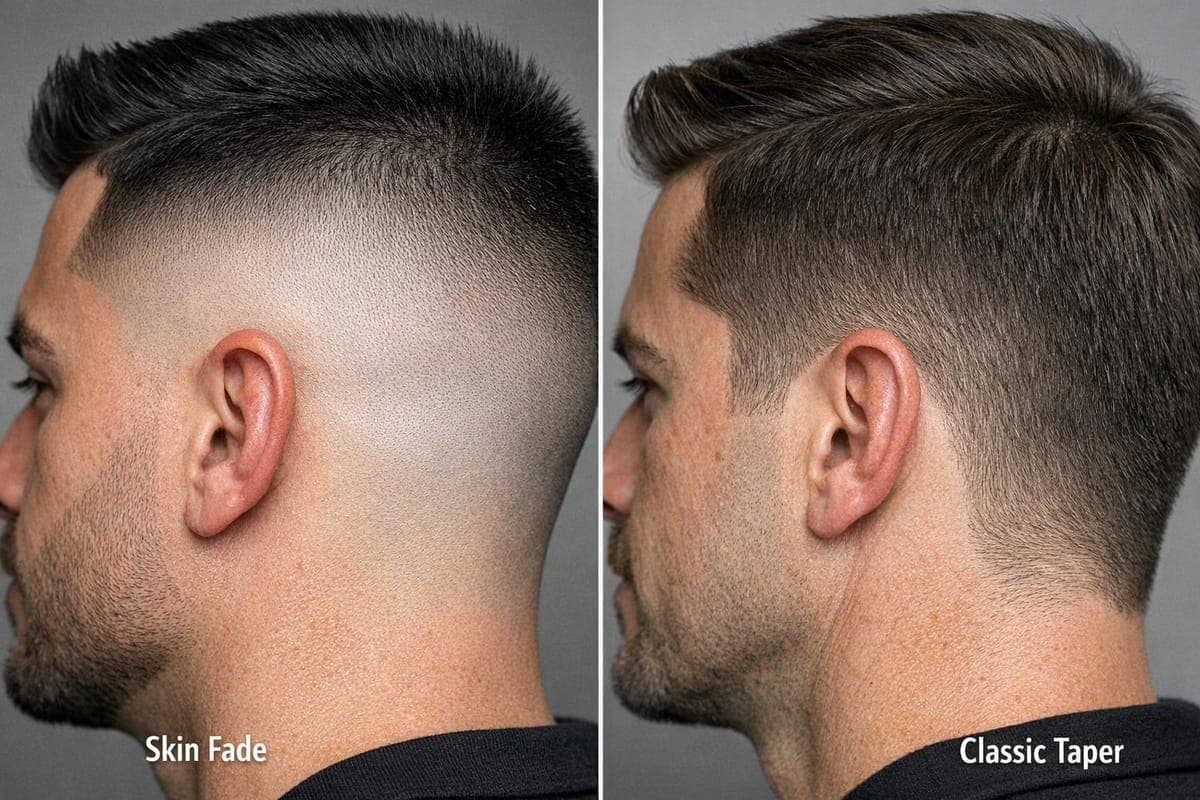
Fade and taper are the two most common terms men hear at the barber — and most men don't know the difference. The result is a lot of appointments where you ask for one thing and get something close but not quite right. This guide explains exactly what each term means, how they look side by side, how to choose between them based on your face shape and lifestyle, and what to say to your barber to get the result you actually want.
Quick answer: fade vs taper
| Feature | Taper | Fade |
|---|---|---|
| Goes to skin | No | Yes |
| Maintenance | Every 5–6 weeks | Every 3–4 weeks |
| Look | Classic, subtle | Bold, modern |
| Best for | Professional/conservative | Contemporary/urban |
| Face shapes | All | All (level varies) |
Most men asking for a "fade" actually want a mid skin fade — the most versatile option.
What does a taper look like?
Works well for
- ✓Professional environments (law, finance, corporate)
- ✓Men who visit the barber every 5–6 weeks
- ✓Conservative or classic style preferences
- ✓Older men who prefer a traditional look
Avoid if
- ✗Men who want a bold, modern, high-contrast look
- ✗Men already visiting the barber every 2–3 weeks
What makes it look different from a fade:
— The graduation is subtle. There's no sharp line between hair and no hair.
— The sides stay relatively full compared to a fade.
— The neckline looks natural rather than clean-edged.
— After 5–6 weeks of growth it still looks intentional.
A taper is the most traditional barbershop technique. It's what most men got before the modern fade dominated in the 2010s. Still the right choice for professional environments, conservative aesthetics, and men who prefer a longer window between cuts.
Not sure if this cut will suit you?
Preview it on your own face before booking the barber — takes 30 seconds.
AI reads your hairline, face shape & density. Free to try.
Preview on my face — freeWhat does a skin fade look like?
What makes it look different from a taper:
— There is a visible, clean line where skin becomes hair.
— The contrast between the sides and top is high and deliberate.
— It looks razor-sharp for 2–3 weeks, then grows out visibly.
— Under good light, the gradient from skin to full hair is the defining visual feature.
Fades are the dominant style in modern barbering. A mid skin fade is the most versatile default — it works on most face shapes, hair types, and with most top styles.
High fade vs mid fade vs low fade — which level is right?
Works well for
- ✓High fade: square and oval faces, bold modern looks
- ✓Mid fade: all face shapes, everyday versatility
- ✓Low fade: professional settings, oblong and heart faces
Avoid if
- ✗High fade: round faces (emphasises width)
- ✗Low fade: men who want a modern, high-contrast urban look
High fade
Starts near the temples — roughly level with the top of the ear or above. Creates strong contrast and a very modern, bold look. The top of the head feels visually separated from the sides. Best for square and oval faces. Makes the face look more angular and defined. Also the best option for thinning hair — see the thinning hair section below.
Mid fade
Starts at the midpoint of the sides — roughly level with the middle of the ear. The most versatile option. Works with nearly every face shape and hair type. The default recommendation if you're unsure. Not as bold as a high fade, not as conservative as a low fade.
Low fade
Starts just above the ear and neckline. Subtle — almost like a taper, just cleaner at the bottom. Better for professional environments and conservative settings. Suits oblong and heart faces well. Lasts longer between cuts than a high fade.
| Fade level | Starts at | Best for | Frequency |
|---|---|---|---|
| High | Above the ear / temples | Square, oval faces; bold looks | Every 2–3 weeks |
| Mid | Mid-ear | Most face shapes; everyday | Every 3–4 weeks |
| Low | Just above ear | Heart, oblong; professional | Every 4–5 weeks |
Skin fade vs taper fade — what's the difference?
A skin fade goes all the way to bare skin at the lowest point. Skin is fully visible. Maximum contrast.
A taper fade combines both techniques — it graduates gradually (taper) but does reach skin at the bottom (fade). The result is less abrupt than a skin fade but cleaner than a pure taper. The gradient is longer and smoother.
For a more detailed breakdown of each variation, see the skin fade vs taper fade guide.
Most men who ask for a "taper fade" are actually describing a mid or low skin fade with a gradual gradient. The terms overlap heavily in practice — what matters more is specifying the level (high/mid/low) and how far down it goes (to skin or not).
Drop fade vs burst fade — what are they?
Drop fade
A drop fade curves downward behind the ear, "dropping" lower at the back of the head than the front. It gives a more natural, rounded look compared to a straight horizontal fade. Popular for men with longer hair on top or a quiff — the drop creates a more fluid shape. The neckline looks clean and deliberate.
Burst fade
A burst fade curves in a semicircle directly around the ear, fanning outward. Unlike a standard fade which runs horizontally across the sides, a burst fade is centred on the ear. Popular with afro-textured hair and longer styles on top (especially mohawks and faux-hawks). It creates a very distinctive arc shape that draws attention to the top.
| Variation | Shape | Best for |
|---|---|---|
| Standard fade | Horizontal line | Most styles |
| Drop fade | Curves lower at the back | Quiffs, longer tops |
| Burst fade | Arc around the ear | Textured tops, afro hair |
If you're unsure between these and a standard fade, tell your barber what top style you want — they'll usually recommend the right fade shape.
Which fade works best for thinning hair?
What to say to your barber
“I have some thinning on top and I want the fade to distract from it. High skin fade on the sides — I want the focus to be on the clean fade line, not the top. Keep the top under an inch, textured, matte finish.”
Thinning on top creates contrast — the full sides next to sparse top draws the eye upward to the problem area. A high skin fade inverts this. The contrast is now in the fade itself (the clean skin-to-hair gradient), not between sides and top. The eye is drawn to the fade line, not the top.
Keep the top under 1 inch and use matte product — shine makes every gap in the hairline visible under light.
For more on styles specifically for thinning hair, see the best haircuts for thinning crown men and best hairstyles for balding men guides.
Which should I choose? A 3-question decision guide
Every 2–3 weeks → skin fade (high or mid)
Every 4–5 weeks → taper fade or low fade
Every 5–6 weeks → taper
Question 2: What environment are you in most?
Professional / corporate / formal → taper or low fade
Casual / creative / urban → mid or high fade
Mixed → mid fade (versatile enough for both)
Question 3: What face shape do you have?
Oval or square → high fade (adds angularity)
Round → mid or high fade (tight sides slim the face)
Oblong / rectangular → low fade or taper (avoids extra height)
Heart / triangle → low fade or taper (avoids emphasis on wide forehead)
If you're unsure of your face shape, upload a photo for a free AI analysis — it identifies your face shape and recommends the right level.
Which lasts longer between cuts?
Skin fades — especially high ones — grow out much faster. A high skin fade can look blurry within 2–3 weeks as hair grows back through the faded area. Most men with skin fades visit the barber every 3–4 weeks.
If you can only get to the barber every 5–6 weeks, a taper or low fade is significantly more practical. If you're already going every 3–4 weeks, a high skin fade is fine.
What to say at the barber
What to say to your barber
“Mid skin fade on the sides — faded down to skin starting from the mid-point. Keep the top textured and about an inch long. Not too sharp at the top of the fade.”
1. Level — low, mid, or high (where the fade starts)
2. Depth — skin, shadow, or natural (how short it goes at the bottom)
3. Shape — standard, drop, or burst
4. Top length — how much to keep on top
For a mid skin fade: "Mid skin fade on the sides — faded down to skin, starting from the mid-point. Keep [X inches] on top, textured."
For a high skin fade: "High skin fade — start the fade up near the temples, take it all the way down to skin. Keep it tight on top."
For a low fade: "Low fade — start the fade just above the ears, keep it subtle. Natural at the back."
For a taper: "Natural taper on the sides and back — don't go to skin, just get gradually shorter toward the neckline. Classic look."
For a drop fade: "Skin fade — but I want it to drop lower at the back. Start mid on the sides and let it curve down behind the ear."
Not sure which suits your face shape? Upload a photo for a free AI analysis — it recommends the right fade level for your specific face shape and hairline.
Frequently asked questions
- What is the difference between a fade and a taper?
- A taper gradually reduces hair length toward the neckline and ears but never reaches skin. A fade takes the hair all the way down to bare skin. Tapers are subtler and lower maintenance (5–6 weeks between cuts); fades are bolder and need cuts every 3–4 weeks.
- Is a taper fade the same as a fade?
- Not exactly. A taper fade combines the gradual taper technique with the fade technique — it graduates slowly but does go to skin at the bottom. It's slightly less abrupt than a standard skin fade and is one of the most popular styles in modern barbering. In practice the terms are often used interchangeably, so always specify the level (high/mid/low) and depth (to skin or not).
- Which is better for a round face — fade or taper?
- A high or mid fade is better for a round face. The tight sides reduce apparent width, and a high fade creates a strong vertical line that slims the face. A low taper can actually add apparent width by leaving more hair on the sides.
- What is a drop fade?
- A drop fade curves downward behind the ear, dropping lower at the back of the head than at the front. It gives a more rounded, natural-looking fade shape compared to a standard horizontal fade. Popular with quiffs and longer styles on top.
- What is a burst fade?
- A burst fade curves in a semicircle directly around the ear, fanning outward from it. Unlike a standard fade which runs across the sides in a horizontal line, a burst fade is centred on the ear. Popular with afro-textured hair and longer tops like faux-hawks.
- How long does a skin fade take to grow out?
- A skin fade starts to look fuzzy (rather than cleanly faded) within 2–3 weeks for most men. For the fade to look genuinely sharp, most men need a cut every 3–4 weeks. A low fade or taper lasts 5–6 weeks.
- Can I ask for a fade if I have thinning hair on top?
- Yes — a high skin fade is actually one of the best choices for thinning hair. The short, clean sides reduce contrast with the thinning top and draw attention to the fade line rather than the hair loss. Keep the top short and use matte product.
- What does 'shadow fade' mean?
- A shadow fade is a very subtle fade — it gets extremely short but stops just short of skin. The result looks almost like a taper but with a slightly cleaner line at the bottom. Less dramatic than a skin fade, more modern than a traditional taper. Good middle ground for men who want something contemporary but not high-contrast.
- What is the most popular fade for men in 2026?
- The mid skin fade remains the most popular fade in 2026. It's the most versatile option — not as bold as a high fade, not as conservative as a low fade — and works with almost every face shape and hair type.
- Should I get a high fade or mid fade?
- Get a high fade if you have an oval or square face, visit the barber every 2–3 weeks, and want a bold modern look. Get a mid fade if you're unsure, want something versatile, or can only get to the barber every 3–4 weeks. The mid fade is the safer default for most men.
Free · 30 seconds · No account needed
Don't gamble on your next haircut
You only get a haircut every few months. Make sure it's the right one.
Upload a photo and preview styles on your own face before you sit in the barber chair. AI reads your hairline, face shape, and density — no generic advice.
See your next haircut — freePhoto deleted after 30 days · No spam · No account required